Condition
Knee Pain
A hinge caught between two ball joints, absorbing everyone else's mistakes.
25%
of adults experience frequent knee pain
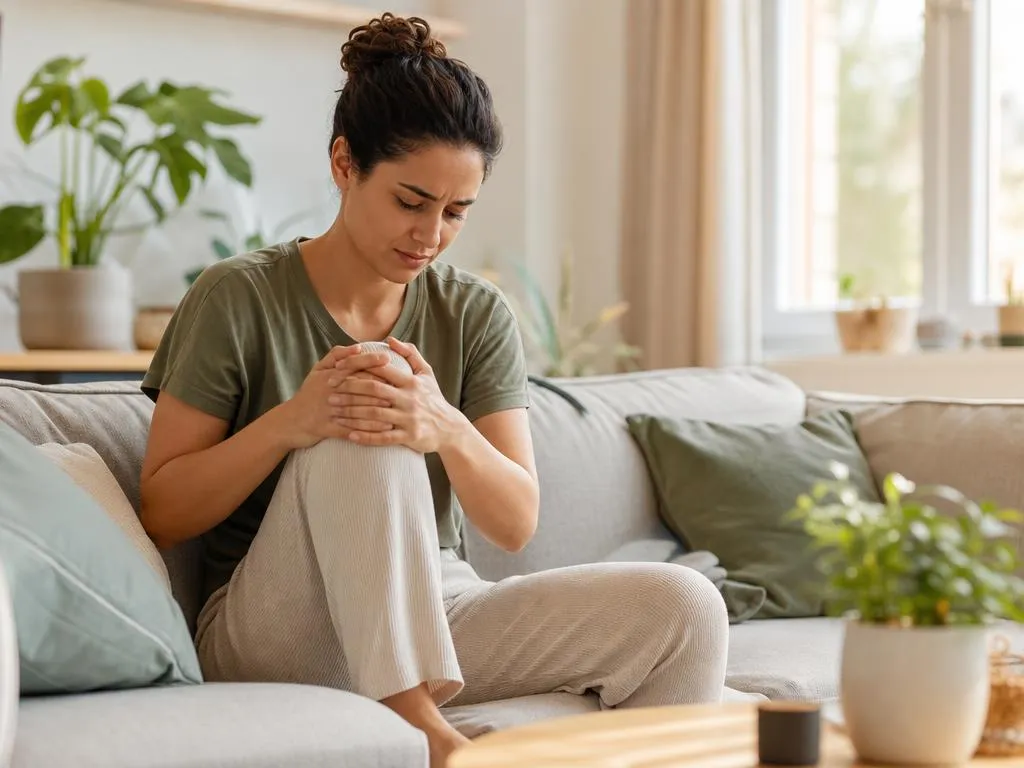
The knee does one thing well — bend and straighten. When the hip or the foot stops controlling rotation, the knee takes it, and that is where most non-traumatic knee pain begins.
What it feels like
- Aching around or behind the kneecap, worse on stairs and after sitting
- Pain on the outside of the knee that appears at a predictable distance running
- Medial joint line pain with twisting, squatting, or getting out of a car
- Swelling, either immediate after injury or gradual over a day
- Catching, locking, or giving way
- Morning stiffness that eases within thirty minutes
What tends to cause it
- Patellofemoral pain — the most common non-traumatic cause by a distance
- Iliotibial band syndrome, typical in runners and cyclists
- Meniscus injury, from trauma in the young and degeneration with age
- Knee osteoarthritis
- Patellar or quadriceps tendinopathy
- Ligament injury — ACL, MCL, LCL, PCL
The knee is essentially a hinge. It flexes and extends, with a small amount of rotation available near full flexion, and that is close to the whole repertoire.
Above it sits the hip — a ball and socket that rotates freely in three planes. Below it sits the ankle and foot complex, which also rotates. The knee is stuck between two mobile joints, and when either of them stops managing rotation properly, the knee is where that rotation ends up.
This is why examining a painful knee in isolation misses the cause so often.
The pattern we see most
A runner develops pain around the kneecap. Video shows the knee collapsing inward during single-leg stance. Testing shows weak hip abductors on that side.
The knee is not the problem. It is where the problem is being felt. Strengthen the hip and the knee pain resolves — which is a strange sentence until you have watched it happen repeatedly.
Sorting the common presentations by location
Around and behind the kneecap — patellofemoral pain. Worse on stairs, after prolonged sitting, and with squatting. The most common non-traumatic knee complaint by a wide margin.
Outside of the knee — iliotibial band syndrome, especially if it appears at a predictable distance into a run and stops when you stop.
Medial joint line — meniscus or medial compartment arthritis. Twisting and getting out of a car are typical aggravators.
Below the kneecap — patellar tendinopathy. Jumping athletes, load-related, tender at a precise point.
The meniscus conversation
This deserves its own note because the research genuinely changed practice.
Arthroscopic partial meniscectomy was for years one of the most commonly performed orthopedic procedures. Then several well-designed trials compared it to exercise therapy, and to sham surgery, in patients with degenerative tears. The results did not favour surgery.
Meanwhile, imaging studies of people with no knee pain found meniscal tears in a substantial proportion, rising steeply with age. A tear on your scan is often an incidental finding.
None of that applies to a young athlete with a traumatic tear and a knee that genuinely locks. It applies to the far larger group told they need surgery for a degenerative finding on an image.
How we treat it here
Screen the hip and the foot
The knee is a hinge between two joints that rotate. Poor hip abduction control lets the femur drop inward; excessive foot pronation rotates the tibia. Either one loads the knee in a plane it does not tolerate. We test both before concluding anything about the knee.
Establish whether it is mechanical or degenerative
True locking and catching suggests something physically in the way. Diffuse aching that worsens with activity and eases with rest looks more degenerative or overload-driven. These lead in different directions.
Load what is missing
Quadriceps and hip abductor strengthening has strong evidence for both patellofemoral pain and knee osteoarthritis. It is unexciting and it consistently outperforms most passive alternatives.
Modify while you rebuild
Adjust running volume, squat depth, or stair frequency temporarily. Reducing irritation while capacity builds is not the same as resting, and it works far better.
Knee pain
Questions we get about this.
Is running bad for my knees?
No, and the data is fairly consistent on this. Recreational runners have lower rates of knee osteoarthritis than sedentary people. Cartilage responds to cyclical loading — it is how it stays healthy. What causes running injuries is a rapid increase in load, not running as such. Sudden jumps in volume, intensity, or surface are the pattern we see.
My MRI shows a meniscus tear. Do I need surgery?
For a degenerative meniscus tear without mechanical locking, probably not. Multiple high-quality randomised trials have compared arthroscopic partial meniscectomy against exercise therapy and against sham surgery, and found no meaningful advantage for surgery in that population. Degenerative meniscal changes are also extremely common in people with no knee pain at all. Traumatic tears in younger patients, and tears causing genuine mechanical locking, are a different conversation.
Should I use a brace?
Sometimes helpful short term for confidence and proprioceptive feedback, particularly after ligament injury. Not a long-term solution, because it does not build the capacity that keeps the knee stable. Use it to get moving, then work toward not needing it.
Does knee arthritis mean I should stop exercising?
The opposite. Exercise therapy is a first-line recommendation in essentially every clinical guideline for knee osteoarthritis, and quadriceps strengthening has the best support. Activity does not accelerate the arthritis; inactivity accelerates the disability that comes with it.
New patient special — $59 New Patient Visit
Get your knee pain properly examined.
One visit, a real diagnosis, and a plan with a visit count and an end date. If it turns out we are not the right provider, we will say so and point you to who is.
Columbus, OH · Same-week appointments · Most insurance accepted