Service
Shockwave Therapy
Acoustic pressure waves for tendons that stopped healing on their own.
- Visit length
- 10–15 minutes
- Typical course
- 4–6 sessions, one per week
- Discomfort
- Moderate during, brief. We adjust intensity throughout.
- Insurance
- Usually not covered. Priced per session, quoted upfront.
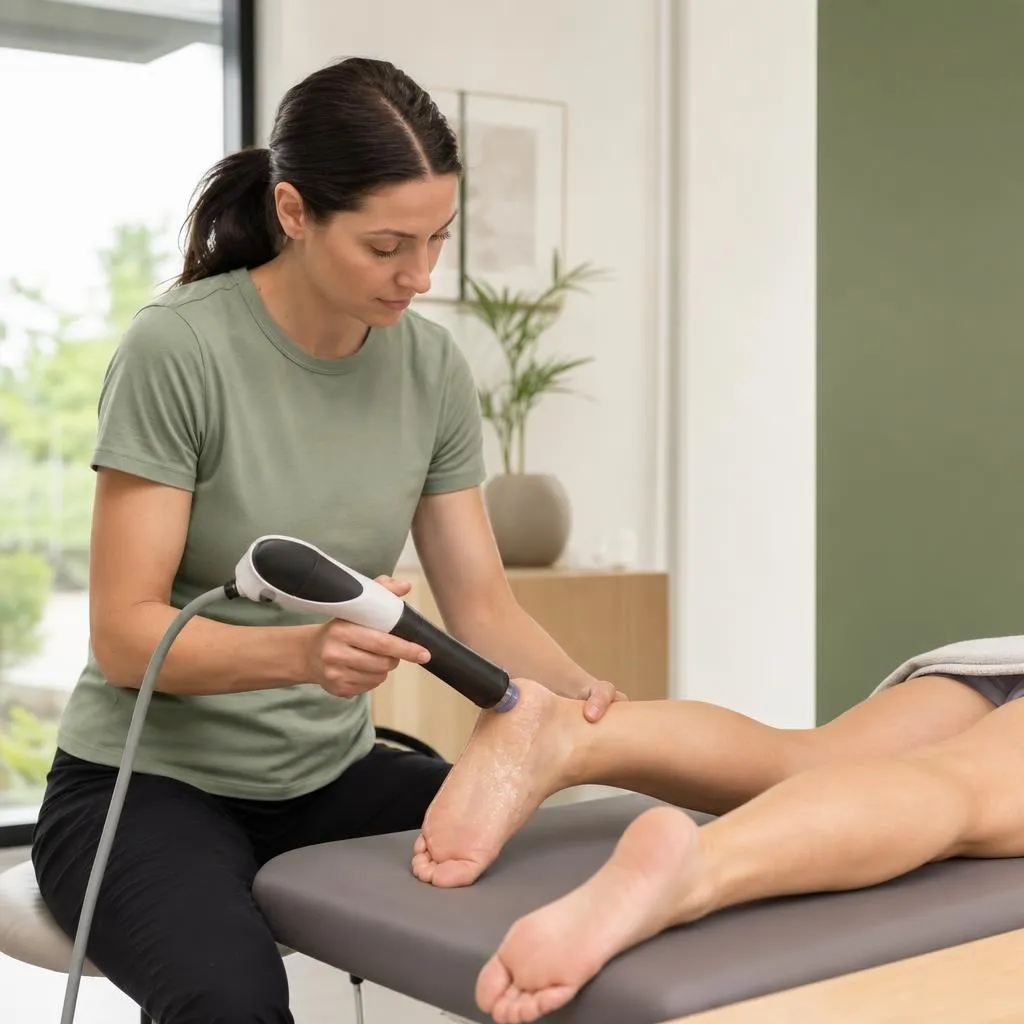
Radial pressure waves delivered into chronic tendon problems to restart a stalled repair response — the go-to for plantar fasciitis and tendinopathy that has outlasted rest.
Tendons have a peculiar failure mode. An acute tendon injury heals well. A chronic one often does not heal at all — it settles into a degenerative state where the tissue is disorganised, poorly supplied with blood, and no longer actively repairing. Rest does not help, because there is no inflammatory process left to calm down.
That is the specific problem shockwave addresses.
What it actually is
Not shocks in the electrical sense. A pneumatic applicator fires a projectile against a metal head placed on your skin, generating acoustic pressure waves that travel into the tissue. The mechanical stimulus provokes a controlled biological response — increased blood flow, new capillary growth, release of growth factors, and in the case of calcific tendinopathy, mechanical breakdown of the deposit.
In effect it convinces a tissue that has given up that it is injured again, so that it restarts the repair it abandoned.
Where the evidence is strongest
Plantar fasciitis is the standout — this is one of the better-supported non-surgical options for heel pain that has persisted past three months. Lateral epicondylitis, calcific shoulder tendinopathy, and greater trochanteric pain syndrome also have solid support. Achilles and patellar tendinopathy respond well when paired with loading.
The condition on the deal
Shockwave without a loading program is half a treatment. The waves open a healing window; eccentric and heavy-slow loading during that window is what lays down organised collagen. Patients who do the exercises do substantially better than patients who only show up for the sessions.
We will not sell you a course unless you are willing to do the loading work alongside it.
How it runs
Confirm it is chronic
Shockwave is for tendon problems that have stalled — generally three months or more. Acute inflammatory injuries need rest and loading, not this. Applying it too early is a common and unhelpful mistake.
Find the exact spot
We locate the lesion by palpation and by your report. The applicator has to sit on the pathology; a centimetre off substantially reduces the effect.
Deliver the pulses
Around 2,000 pulses at an intensity you can tolerate. It is uncomfortable and we will tell you so in advance. Intensity gets adjusted continuously based on your feedback.
Load it afterward
Shockwave creates a window of healing activity. Progressive tendon loading during that window is what turns the response into actual tissue. Sessions without the loading work underperform badly.
Conditions we use this for




Shockwave
What people ask about this.
How much does it hurt?
It is genuinely uncomfortable — a rapid percussive pounding directly on a sore spot. Most people rate it 4 to 6 out of 10 during treatment. It stops the instant the applicator lifts, and there is no lingering pain beyond mild soreness. We turn the intensity down whenever you ask.
How soon does it work?
Most patients notice change after the third session, though it is common to feel slightly worse for a day or two after the first. Full benefit is usually assessed around 8 to 12 weeks after the course finishes, because the tissue remodelling continues long after the last session.
Why is it not covered by insurance?
Most US carriers still classify it as investigational for musculoskeletal use despite a reasonable evidence base, particularly for plantar fasciitis. We quote the full course cost before you start so there are no surprises.
Who should not have it?
Patients who are pregnant, on anticoagulant therapy, have a bleeding disorder, have a tumour or infection at the site, or have a joint replacement or growth plate in the treatment area. Nerve and large vessel locations are avoided.
New patient special — $59 New Patient Visit
Not sure shockwave is what you need?
That is exactly what the first visit determines. If the exam points somewhere else, we will tell you — and if it points outside this clinic, we will refer you.
Columbus, OH · Same-week appointments · Most insurance accepted