Service
Posture + Scoliosis Care
Measured, tracked, and honest about what can change.
- Visit length
- 30 minutes
- Typical course
- 12 weeks with re-measurement at week six
- Discomfort
- Low. Some fatigue from the loading work.
- Insurance
- Often, when tied to a symptomatic diagnosis
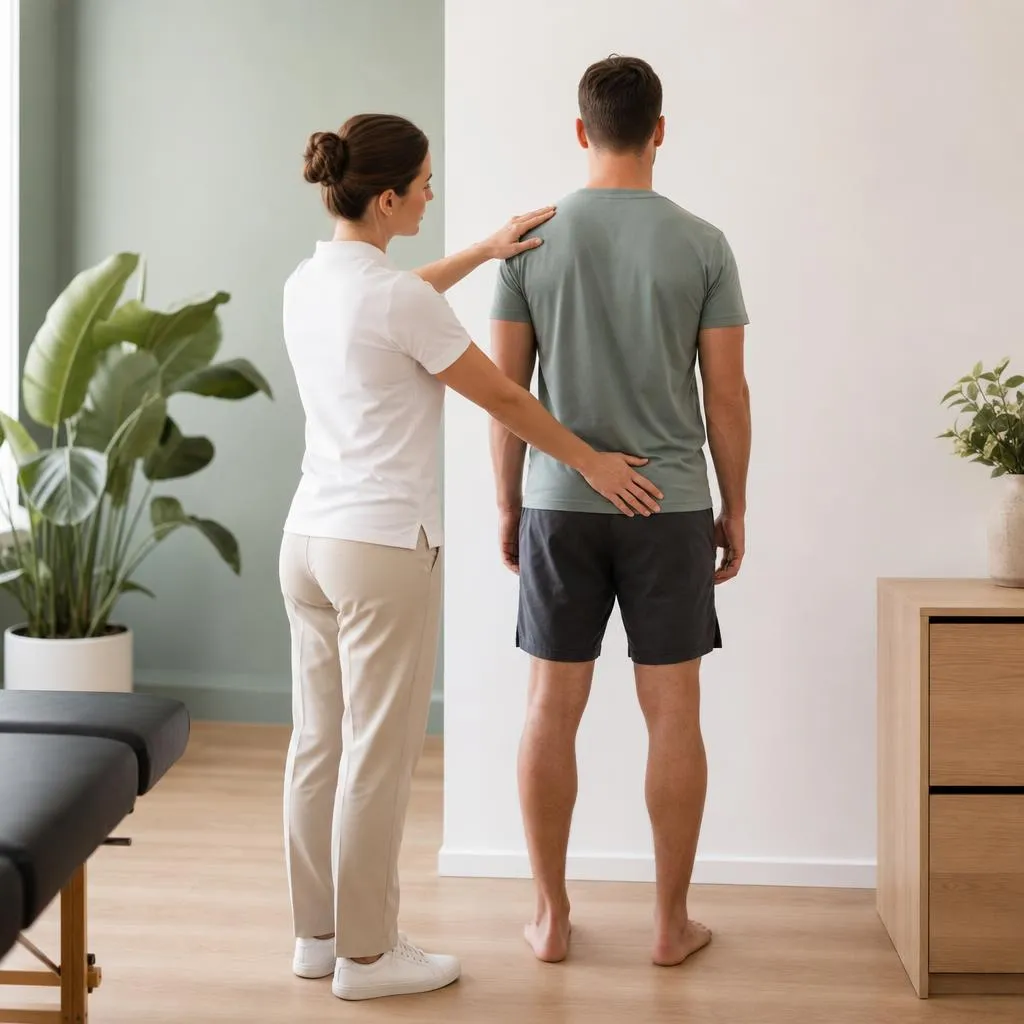
Structured care for postural pain and mild-to-moderate scoliosis, with real measurements at intake and re-exam — and a clear line about what conservative care can and cannot do.
Posture is the most oversold topic in this profession. It is also genuinely worth addressing when it lines up with your symptoms. Both things are true, and the difference is measurement.
What the research actually supports
The idea that there is one correct posture and that deviation from it causes pain has not held up well. Large studies keep finding people with dramatic postural asymmetry and no pain at all, and people with textbook alignment who hurt constantly.
What does hold up is this: sustained postures cause trouble. The problem is usually not how you are sitting. It is that you have been sitting that way for four hours without changing anything. Tissue under constant low load creeps, muscles fatigue, and joints start reporting.
That reframe changes what we prescribe. Less time correcting your chair position, more time building the endurance to hold a position and the habit of leaving it.
Scoliosis, said plainly
A structural scoliosis is a three-dimensional rotation of the spine, and in a skeletally mature adult it does not un-rotate. Conservative care aims at symptoms and function — which for most symptomatic adults is what they actually came in for.
For adolescents, the entire game is progression risk during growth. That is co-managed. We measure, we track, and we refer to an orthopedic specialist at the thresholds above. Anyone who tells a parent they can correct a growing child’s curve with adjustments alone is not being straight with them.
How it runs
Measure it properly
Postural photography with a plumb reference, forward-head measurement in degrees, shoulder and pelvic levelling, and Adams forward-bend testing. Radiographic Cobb angle where a curve warrants it.
Separate habit from structure
A postural pattern you can correct on request is a control problem. One that does not change when you try is structural. These need entirely different plans and it is the first thing we determine.
Load the endurance side
Postural muscles fail on endurance, not strength. The programming reflects that — longer holds, lighter loads, more frequency.
Re-measure at week six
Same photos, same landmarks, same conditions. Numbers, not impressions. If the numbers have not moved we change approach or refer.



Posture + scoliosis
What people ask about this.
Can chiropractic straighten a scoliosis?
For an adult with an established structural curve, no — and anyone promising otherwise is overselling. What conservative care can reliably do is reduce the pain, stiffness, and fatigue that come with the curve, and improve function. For adolescents still growing, curve progression is the concern, and that is co-managed with an orthopedic specialist. Bracing and, in some cases, surgery are their domain, not ours.
When does a curve need a specialist?
We refer for any adolescent curve over roughly 20 degrees, any curve progressing more than 5 degrees between measurements, any curve with neurological findings, and any painful curve in a skeletally immature patient. We would rather refer early and be wrong than late and be right.
Is forward head posture actually a problem?
It correlates with neck pain and headaches, but the relationship is weaker than the internet suggests — plenty of people with significant forward head carriage have no symptoms at all. We treat it when it lines up with your findings, not because a photo looks bad.
Will a posture brace help?
Short term, some people find them useful as a reminder. Long term, passive support does not build the endurance that holds posture, and there is reasonable concern about dependence. We use them sparingly and always alongside active work.
New patient special — $59 New Patient Visit
Not sure posture + scoliosis is what you need?
That is exactly what the first visit determines. If the exam points somewhere else, we will tell you — and if it points outside this clinic, we will refer you.
Columbus, OH · Same-week appointments · Most insurance accepted