Service
Chiropractic Adjustment
Restoring motion to the joints that stopped contributing.
- Visit length
- 15–25 minutes after the first visit
- Typical course
- 6–12 visits for most new complaints
- Discomfort
- Usually none. Occasional next-day soreness like after a workout.
- Insurance
- Yes, by most major plans
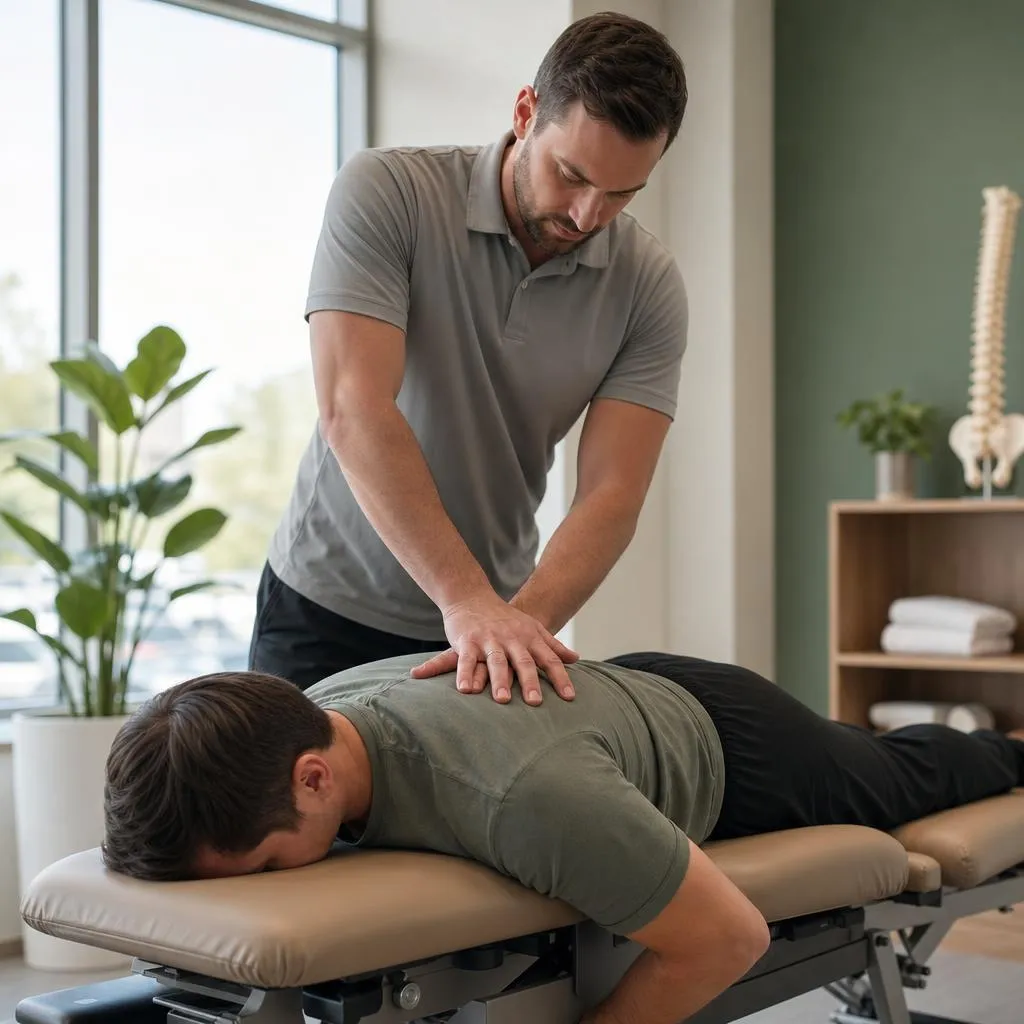
A specific, tested adjustment to the segments that are actually restricted — not a routine head-to-toe crack.
An adjustment is a small, fast, precisely aimed force applied to a joint that is not moving the way it should. That is the whole of it. The value is not in the force — it is in knowing exactly which joint to apply it to, and having tested that beforehand.
What restriction actually means
Spinal joints are designed to glide, tilt, and rotate through a specific range. When one loses part of that range — from injury, from sustained posture, from guarding after a strain — the segments above and below start compensating. They take on motion they were not built for. Over months, that is what turns a small mechanical problem into a persistent one.
Restoring motion to the restricted segment takes the borrowed load off its neighbours. That is the mechanism, and it is why we test segment by segment rather than adjusting everything on principle.
What we will not do
We do not adjust joints that test as hypermobile. In a spine where one region is stiff and the next is too loose, adjusting the loose region feels dramatic and makes the problem worse. This is one of the most common mistakes in the profession, and avoiding it is most of what separates a targeted adjustment from a routine one.
What it feels like
Brief pressure, sometimes an audible release, then a noticeable change in how the area moves. Most patients describe relief rather than pain. If you are nervous — and plenty of people are, especially about the neck — tell us. There is a low-force option for every region of the spine, and choosing it costs you nothing in results.
How it runs
Test the segment
We move each joint through its range individually to find which ones are genuinely restricted. This is the step that decides everything after it.
Choose the technique
Manual (diversified), instrument-assisted (Activator), or drop-table. The choice depends on your findings, your comfort, and your bone health — not on clinic habit.
Deliver and re-test
One specific thrust or impulse, then we re-check the same segment. If it did not change, we do not repeat it harder — we reconsider the diagnosis.



Adjustment
What people ask about this.
Does the popping sound mean something moved back into place?
No. That sound is a gas bubble releasing inside the joint capsule, and it has no relationship to whether the adjustment worked. Plenty of effective adjustments are silent. Nothing is going "out of place" and being put back.
Is it safe?
For the general population, yes. Serious complications from spinal manipulation are rare. The most common side effect is temporary soreness for a day. We screen for the specific conditions where manipulation is not appropriate — including significant osteoporosis, inflammatory arthritis, fracture, and certain vascular risk factors — before we ever adjust you.
Will I need to keep coming forever?
No. Most people with a new complaint are discharged within six to twelve visits. Ongoing maintenance care is a preference some patients choose, not a clinical requirement we impose.
Can I be adjusted without the twisting?
Yes. Instrument-assisted and drop-table techniques produce similar results without rotation, and we use them routinely for patients who prefer them or whose findings call for them.
New patient special — $59 New Patient Visit
Not sure adjustment is what you need?
That is exactly what the first visit determines. If the exam points somewhere else, we will tell you — and if it points outside this clinic, we will refer you.
Columbus, OH · Same-week appointments · Most insurance accepted