Service
Spinal Decompression
Non-surgical traction for discs that are genuinely under load.
- Visit length
- 20–30 minutes on the table
- Typical course
- 12–20 sessions over 6–8 weeks
- Discomfort
- None. Most patients find it relaxing enough to fall asleep.
- Insurance
- Varies — often out of pocket. We quote it before you start.
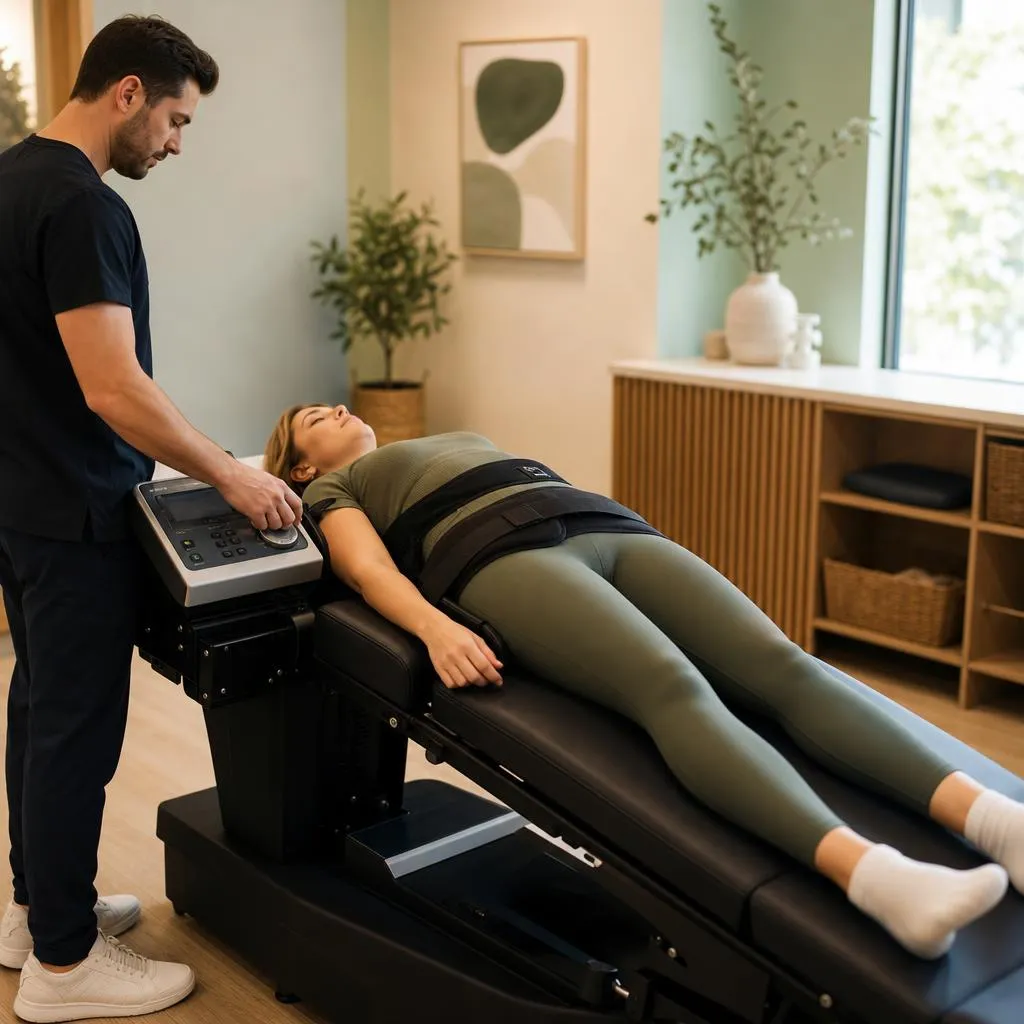
A motorized table that creates negative pressure inside the disc, used for confirmed disc involvement — not as a general back-pain package.
Spinal decompression is a motorized traction table that applies and releases a controlled pull along the axis of the spine. The cycling is the point. As the pull builds, pressure inside the targeted disc drops — and a disc under negative pressure behaves very differently from one being compressed by your body weight all day.
Why the disc is a hard tissue to help
The intervertebral disc has almost no direct blood supply after childhood. It gets nutrients by diffusion, driven by pressure changes as you move and unload. This is why disc problems can be so stubborn and so slow: the tissue’s own repair mechanism depends on movement it hurts to perform.
Decompression drives that pressure cycle mechanically, without asking a painful spine to produce it. That is the honest case for the technology, and it is a reasonable one.
Being straight about the evidence
The research on non-surgical decompression is positive but not overwhelming, and the studies are smaller than we would like. It is not magic and it is not right for every back. What we can say is that for patients with confirmed disc involvement and radiating symptoms, it is a legitimate option worth trying before an injection or a surgical consult.
What we will not do is sell a twenty-session package to someone whose exam points at a facet joint. That is where this treatment gets its bad reputation, and the reputation is deserved.
What a course looks like
Most protocols run three sessions a week for four to six weeks, tapering as symptoms improve. You will feel a difference in the first week or the plan changes. We re-test at session six against your starting neurological findings, and you get told plainly whether it is working.
How it runs
Confirm there is a disc involved
Decompression is for disc problems. We use orthopedic testing, neurological findings, and imaging where available to confirm that before recommending a course. If your pain is facet or muscular in origin, this is the wrong tool and we will say so.
Harness and position
You lie fully clothed on the table with a padded harness at the pelvis and trunk. Positioning targets the specific level involved — an L5-S1 protocol is set up differently from an L4-L5.
Cycle the load
The table applies and releases gentle traction in a controlled cycle. That pulsing pattern is what creates the pressure differential; a steady pull would just trigger the muscles to fight back.
Reassess at session six
We re-test your neurological findings and symptom distribution. If nothing has moved by then, we stop and change plan rather than sell you the rest of the package.

Decompression
What people ask about this.
How is this different from an inversion table?
An inversion table applies uncontrolled whole-body traction using gravity. Decompression applies a measured, cyclical, computer-controlled load aimed at a specific spinal level, at forces the table adjusts in real time when your muscles start to resist. They are not comparable interventions.
Does it hurt?
It should not. The sensation is a gentle stretch through the low back that builds and releases. If anything is painful we stop and adjust the setup — pain during a session means the parameters are wrong.
Is it a permanent fix?
Decompression reduces the mechanical load on the disc. Keeping it that way depends on what you do afterward, which is why every decompression course here is paired with progressive loading work. Discs that heal and then get exposed to the same movement patterns tend to complain again.
Who should not have it?
Patients with spinal fractures, surgical hardware at the treated level, severe osteoporosis, tumour, abdominal aortic aneurysm, or pregnancy. We screen for all of these before your first session.
New patient special — $59 New Patient Visit
Not sure decompression is what you need?
That is exactly what the first visit determines. If the exam points somewhere else, we will tell you — and if it points outside this clinic, we will refer you.
Columbus, OH · Same-week appointments · Most insurance accepted